New Study Suggests Following Canada’s Food Guide Could Help You Live Longer
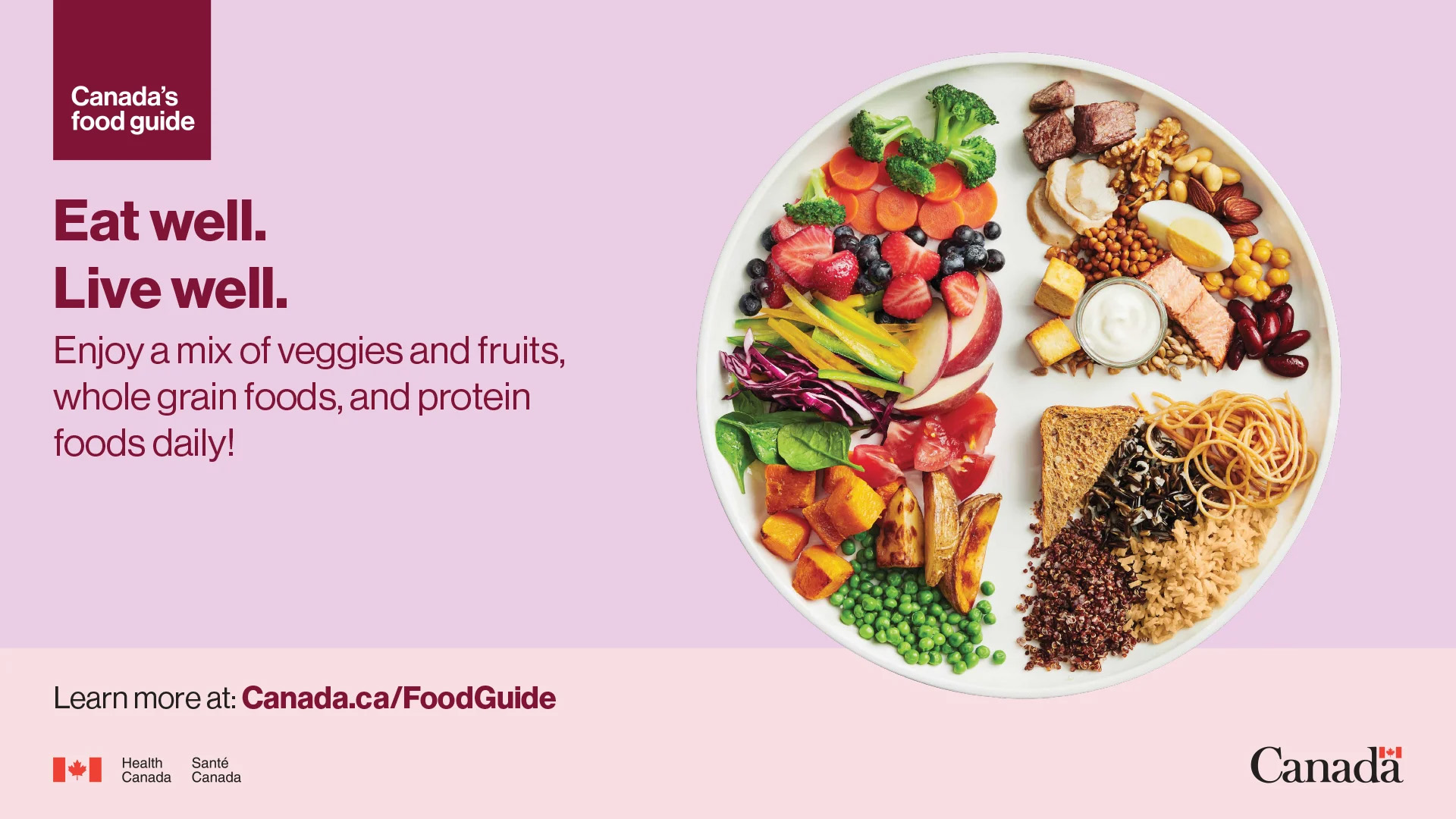
Healthy eating is essential for your overall health, but could improving your diet to better align with Canada’s Food Guide also help you live longer? A 2026 study published in the American Journal of Preventive Medicine explored this question by examining the relationship between dietary guideline adherence and mortality among Canadian adults.
How was the study conducted?
Researchers analyzed data from 15,835 Canadian adults aged 20 and older who participated in the 2004 Canadian Community Health Survey-Nutrition. They assessed how closely participants’ diets aligned with Canada’s Food Guide 2019 using the Healthy Eating Food Index (HEFI-2019), scored from 0 to 80. Participants’ records were linked to mortality data through 2017.
Using a method called target trial emulation, the researchers used observational data to model how mortality risk might differ under various dietary adherence scenarios. Because participants were not randomly assigned to change their diets, the findings suggest potential benefits but cannot prove that dietary changes directly caused them.
What did the study find?
The researchers modelled what might happen if Canadians shifted to optimal adherence to Canada’s Food Guide, compared with maintaining their usual diets. This scenario was associated with a lower estimated risk of death over both five years and 13 years.
Under the modelled optimal-adherence scenario, estimated life expectancy at age 45 increased by 1.7 years for women and 3.0 years for men over the 13-year modelling horizon. These are estimates from statistical modelling, rather than additional years of life actually observed among participants.
The researchers also examined scenarios targeting adults aged 45–80 years in groups facing socioeconomic disadvantages. The clearest population-level benefit was found when targeting adults with less than secondary school education. In this group, shifting diets to optimal adherence was associated with a 28% lower estimated population-level risk of death over the shorter five-year period. This was comparable to the benefit estimated for universal high adherence among all adults aged 45–80 years. This suggests that helping groups facing socioeconomic barriers to healthy eating could have meaningful public health benefits.
Study limitations to keep in mind
Although the findings are encouraging, the study has limitations. The researchers used dietary information collected in 2004 and assessed it against the 2019 Canada’s Food Guide. Diets may have changed over time, and other factors could partly explain the observed associations. Further, the estimated benefits were modelled rather than measured following an actual dietary intervention.
How can you follow Canada’s Food Guide?
Canada’s Food Guide encourages a balanced eating pattern that emphasizes vegetables and fruits, whole grains and protein foods, with plant-based protein choices encouraged.
Practical ways to put its recommendations into action include:
- Try making half of your plate vegetables and fruits.
- Choose a variety of whole-grain foods every day, such as oatmeal, whole-grain bread, whole grain pasta, whole-grain brown or wild rice.
- Include protein foods such as beans, lentils, nuts, seeds, meat and poultry, fish, eggs, lower fat milk and lower fat dairy products.
- Choose foods with healthy fats instead of saturated fats.
- Choose water as your drink of choice more often.
- Limit highly processed foods.
- Prepare meals and snacks using ingredients that have little to no added sodium, sugars or saturated fats.
The bottom line
Researchers from this study estimate that greater adherence to Canada’s Food Guide could lower estimated mortality and could extend life expectancy, while highlighting the importance of making healthy eating more accessible to everyone. Although further research is needed, choosing a variety of nutritious foods and building healthy eating habits are practical steps toward supporting long-term health.